

· AFX Research
What Boundary Disputes and Adverse Claims Mean for SBA Collateral
A contested line can make the secured parcel smaller than the appraisal assumed. What the record surfaces, what only a survey shows, and why neither works alone.
Table of Contents
A lender takes a commercial parcel as collateral, the appraisal values it on the described acreage, and a neighbor has been parking on the back third for eighteen years behind a fence that sits well inside the line. Nothing about that appears in an ordinary file. It appears at liquidation, when a buyer’s surveyor finds it and the price moves. Boundary problems are among the least visible defects in collateral and among the more expensive, and finding them takes two documents rather than one.
Three ways a line gets disputed
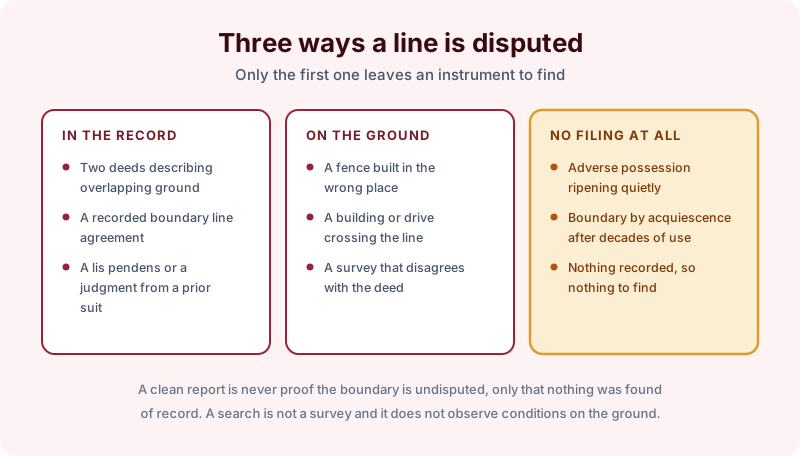
In the record. Two deeds describing overlapping ground, a recorded boundary line agreement, or a lis pendens or judgment from a prior suit. These a search finds, and a prior recorded agreement is genuinely good news because it means somebody already settled the question in writing.
On the ground. A fence in the wrong place, a building or a drive crossing the line, or a survey that simply disagrees with the deed. None of that is in an index and all of it is visible to a surveyor.
With no filing at all. Adverse possession ripening quietly over the statutory period, or boundary by acquiescence after decades of both owners treating a fence as the line. Nothing was recorded, so nothing will be found, and a clean report is never proof the boundary is undisputed.
The elements and the statutory period differ considerably between states, and some require the claimant to have paid taxes on the disputed strip while others do not. That variation is one more reason this is a question for counsel in the state where the land sits rather than one answered from a general rule.
What it costs a lender
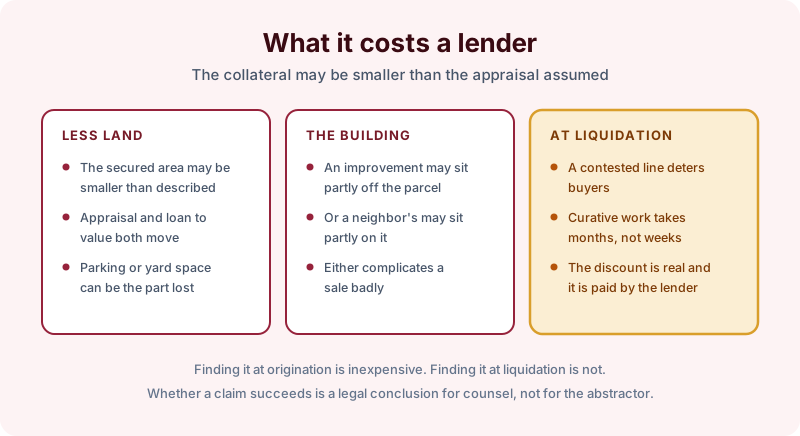
The secured area may be smaller than the description says, which moves the appraisal and the loan to value together. On a commercial parcel the part in dispute is frequently parking or yard space, which is exactly the part a buyer needs.
The improvements are worse. A building or loading area sitting partly off the parcel, or a neighbor’s structure sitting partly on it, complicates any sale considerably.
And at liquidation a contested line deters buyers, curative work runs to months rather than weeks, and the discount is real. All of that is inexpensive to discover at origination, and the same logic drives legal description problems on SBA collateral.
Rural acreage deserves particular attention here, because older parcels described by metes and bounds have had longer for a fence to drift and for the monuments in the description to disappear. Our note on rural acreage collateral covers what else those parcels tend to carry.
The search and the survey together
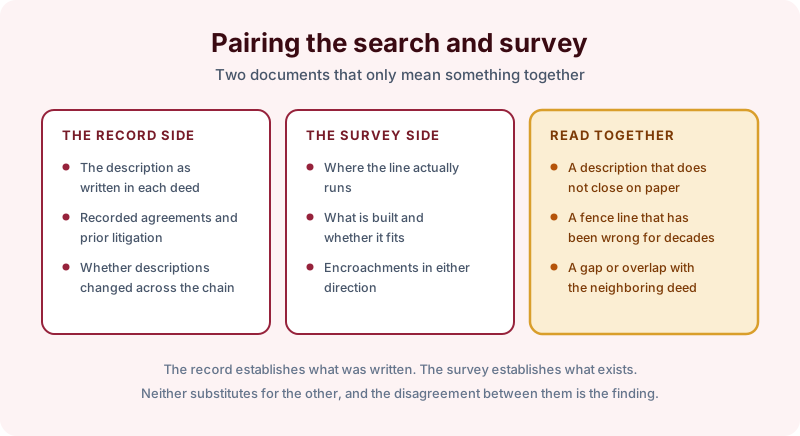
The record side gives you the description as written in each deed across the chain, any recorded agreement or prior litigation, and whether the descriptions changed as the parcel was split or combined. The survey side gives you where the line actually runs, what is built, and any encroachment in either direction.
Read together they produce findings neither yields alone. A description that does not close on paper. A fence line that has been in the wrong place for decades. A gap or an overlap between this deed and the neighboring one. That is why a search is not a survey and a survey is not a search, and why serious commercial collateral usually justifies both.
Whether an adverse claim would actually succeed is a legal conclusion for counsel, turning on that state’s statutory period and elements. We report what was recorded and indexed over the term searched, with the instruments attached, and recording practice varies by county.
The takeaway
Search the chain for overlapping descriptions, prior agreements, and old litigation, then get a survey where the collateral matters, and read the two against each other. A clean search means nothing was found of record rather than that the line is settled. Start the order online, or send us the legal description and the county and we will tell you what a search of that scope would and would not cover before anything is ordered.