

· AFX Research
Reading the Vesting Line on Co-Owned SBA Collateral Property
How the vesting line changes what can be pledged, why every record owner belongs in the search, what a partition suit signals, and what an unrecorded share hides.
Table of Contents
A borrower who owns a building with a sibling, a former partner, or an ex-spouse is describing a normal situation, not an unusual one, and the funding letter rarely says anything about it. The complication is structural. When more than one person holds title, the parcel is not one interest, it is several, and a security instrument signed by one of them may reach considerably less than the file assumes. The starting point is the same as in our note on collateral held in a trust or estate, which is to read the vesting line before anything else.
Three answers hiding in one deed
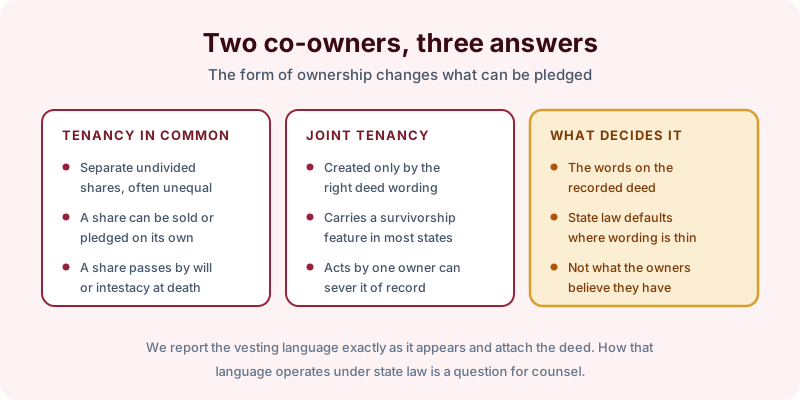
Tenancy in common gives each owner an undivided fractional share of the whole parcel. The shares need not be equal, each one can generally be sold, mortgaged, or willed independently, and none of the owners has an exclusive claim to a particular corner of the ground.
Joint tenancy looks similar on the surface and behaves differently, because in most states it carries a survivorship feature and because one owner acting alone can sever it of record. Which form exists is a function of the words on the recorded deed and the default rules of the state, not of what the owners understood at the time.
There is a third possibility on residential collateral in a number of states, a form of co-ownership between spouses with its own rules about what one of them can encumber alone. Where the collateral is also a home, that intersects with the issues in our note on spousal joinder and homestead.
What one signature actually pledges
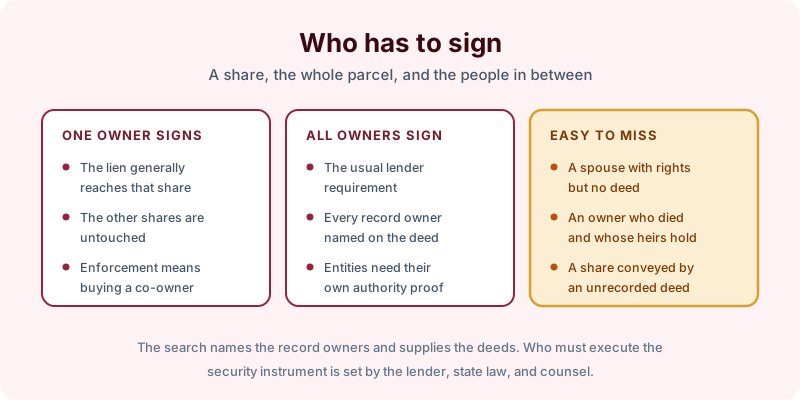
If one co-owner signs the deed of trust, the general result is a lien on that owner’s share rather than on the parcel. That is a materially different piece of collateral. Realizing on it means becoming a co-owner alongside strangers, or funding a partition action, which is slow, public, and expensive.
Lenders solve this by requiring every record owner to execute the security instrument, whether or not they are borrowers or guarantors. Producing that list is a record question, and it is the part that goes wrong when a co-owner has died, when a share was transferred by a deed that never reached the recorder, or when an owner of record is an entity that no longer has an obvious signer.
What the search covers
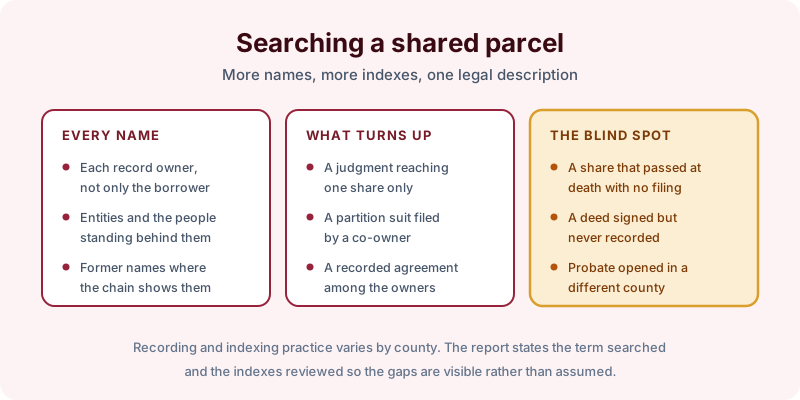
Every record owner goes into the name search, not just the borrower. A judgment against one co-owner attaches to that owner’s interest and travels with the parcel into the transaction, so a search run against the borrower alone can return a clean report on genuinely encumbered collateral. Our note on judgment liens covers how those behave once attached.
Two other signals are worth pulling. A partition suit tells the lender the ownership group is already in conflict, which bears directly on how the collateral would behave in liquidation. A recorded co-ownership or buy-sell agreement can restrict transfers or grant a right of first refusal, the same category of problem covered in our note on purchase options and rights of first refusal.
The limit is worth stating plainly. A search reports what was recorded and indexed over the term searched. Shares frequently pass at death with nothing filed in the county at all, so a vesting line naming four people may be describing eleven, and the last owner named is not necessarily the present owner. Sorting that out is a legal determination for counsel, working from the documents rather than from the index. Where the chain shows a deceased owner and no probate filing, that gap is the item to raise with the borrower early, because curing it takes far longer than ordering another search.
The takeaway
Read the vesting line first, count the owners, and search every one of them. The question is not only what is recorded against the property, it is whose signature is needed to reach the whole of it. Start the order online, or send us the current deed and the names of every owner and we will scope the search to the interests the funding letter actually needs covered.